Thursday, February 19, 2015

3rd Week of February

DOK - From Student Involvement to Student Commitment
I found this quote a few weeks ago and pondered this thought, "How much does involvement play in the arduous task we call learning.  If you think about it, involvement is a pretty big deal.  When kids or even adults don't feel included in any initiative or task, there is a strong chance that they will not choose to take ownership or even an active role in the task.

So how can we involve kids in our learning tasks in a way that will entice them to commit to the learning?
Source:  "Motivational Quotes"
Compiled by Mac Anderson
  1. Leadership - When kids have the opportunity to help you lead the learning, participation grows,
  2. Examples - When examples of student work are used as teaching tools or exemplars of great work, student motivation increases.
  3. Advancement - If students can see how learning tasks advance their abilities and their knowledge, they choose to get involved.
  4. Real-world - When learning is tied to the real-world that students either live in or can relate to, involvement grows.
  5. N-It-4-Me - Every successful lesson answers this ever-present student question, "What's in it for me?"  If you can sell your content to your client, the student, chances are they will not only buy your teaching but sell it to their peers on your behalf.  That's the ultimate form of student commitment to learning.
Learning can't occur at high levels unless there is commitment.  The manner in which we intentionally involve kids in class everyday plays a huge role in determining whether or not kids will choose get involved and ultimately commit to their learning.


STAAR Vocabulary Challenge - How many words do your kids know? 
(Click here for Dynamo.Dictionary.com)

College & Career
  •  The oil and gas business is booming (if you didn't already know that), and there is a huge demand for skilled workers in the areas of welding technology, industrial maintenance, petroleum technology and corrosion technology.  Did you know that in these 4 areas, students enrolled in associate degree programs at Kilgore College are getting hired before they graduate.  In addition these jobs have entry-level salaries that start as low as $40,000 per year and can go as high as $70,000.  
  • College and career isn't just about courses that lead to 4 year degrees.  It is about preparing all kids for a career that will sustain them.  To the right you see the projects that our agriculture mechanics students are doing in preparation for shows this spring.  While these tasks prepare them for competition, students are also being prepared for careers with huge earning potential.
  • This week, take time to share with your students the fact that college isn't just about 4 year degrees.  There are lots of careers that only require a 1 year college certificate or a 2 year associate's degree.


TIP (Tech Integration Pic) of the Week
By Veronica Wilkerson
Kindergarten students are
 using the Dr. Bones App to
 learn about the bones in the human body
 in the Discovery lab.


By Cristi Whiddon
TMS math students use Kahoot! to help reinforce
math facts in support of learning new concepts.


This Week's WebFinds

Great piece on the effects divorce has on learning  -  The Grip of Abandonment by @techninjatodd

Will you join 300,000 kids in the The Global Read Aloud by @pernilleripp

Educator Learning Series - A blog designed to engage educators in tasks that help them be more effective in the classroom. 

Thursday, February 12, 2015

2nd Week of February


Intervention Quote of the Week
Eggy-Word App in 1st Grade
for learning sight-words


Instead of asking, 
"What is wrong with this child, and how do we stop it?" 
We need to be asking, 
"What happened to this child, and how do we help them?"
~Jennifer Ng'Andu~

New FAQ about the STAAR Test.
Growth Mindset - Carol Dweck
I encourage you to watch this video called "The Power of Not Yet".  It is great mindset to teach kids how to look at their learning through the lens of mastery vs. not quite there instead of through the battle of passing vs. failing.


DOK Engagement
Get out Your Cell Phone
Check out www.mentimeter.com.  It is a great tool to engage your kids with their cell phones.

Here is a mentimeter poll for you.  You can access it from your computer, but try it with your phone.
www. govote.at


Results can be seen here.


Valentine Cards Never Get Old
Engagement in learning is all about students finding relevance in the learning tasks that they are given.  Mrs. Ojeda and Mrs. Risner's students are making Valentines for Kids in the hospital and seniors in assisted living (nursing homes).  This is one of Mrs. Ojeda's favorite service projects  of the year because most of the students actually love to 'go back to their roots,' get their hands glittery and be a kid again. In both classes, they have made over 500 Valentine cards.  Some of the people in nursing homes may not get any cards, except for these, during the year, and the project makes her students more aware of the people around them, and, for a few minutes, think about how they can make someone else's life a little brighter - even if only for the day.

Here's the link again if you are wondering exactly where these go, and how they get to the kids and seniors.  http://kvne.com/valentinesforkidsandseniors2015/


Web Resource for Engagement

Our BIG list of resources for student engagement: .


College & Career
Last week was National Signing Day.  If your students were asked where they are committing to go to college what would they say?  Would they say Texas or A&M?  Would they say, "I don't know", or would they say, "I'm not going to college."  Many students don't know what college is all about.  Even more think that they can't go to college, while a huge majority don't think they need to go to college or technical school after graduation.
Students in Mrs. Asaff's biology classes are simulating the 
digestive system in this messy but engaging lab.

College enrollment is down before kids even graduate from high school.  That is because college is a foreign concept to them, but if you think about it, that is something that we can fix.  In our work, we must inspire kids to believe that they are college material and that they have what it takes to pursue a college & career future.  So how can you promote a college-going mindset in your role?

  • Tell students your college story.
  • Share statistics about the benefits of getting a college degree or technical school degree.
  • Talk about careers connected to your content and encourage students to research them.
  • Explain that job opportunities are fewer and wages are less for students who choose not to go to college.
  • Tell students about the potential you see in them to go to college.  Kids need to hear that we see their potential.
College is a long way off even for our seniors, but it is never too early to talk about the importance of pursuing an education after high school.  If we conditioned our kids to pursue college every year beginning with kindergarten, I am confident that National Signing Day would reach even more kids than it does today.


Congratulations to THS CX Debate Team 
THS Debate Team
From L-R:  Malik Allen, Damian Lopez, Nathan McBride,
Kevin Boatman, Chris Starling, Jason McBride
This past weekend was the district CX Debate District Meet.  THS students competed against 4 schools with a total of 11 teams.  Having 'buried the lead' a little bit...Nathan McBride and Kevin Boatman brought home 2nd place and top speaker points, and are HEADED TO STATE!! THS also had one other team (Damian Lopez and Jason McBride) only 1 speaker point away from being 3rd/4th place (and alternate to state). We are so proud of Mrs. Ojeda and her students for their work in taking Eagle Excellence to state.  


Congratulations to our THS Band Members
The following students have advanced to UIL State Solo and Ensemble. Twenty-four total including twirlers advance, and some of the students are going on more than one event.   The students came home with 32 first division medals.  Congratulations to Mr. Applegate, Mrs. Machado and Mr. Wells for their work in leading our students to excellence.

Zack Arbegast, Madison Baker, Kevin Boatman, Taylor Burch, Ania Centers, Brayden Fleming, Ryan Gibson, Destiny Hicks, Breanna Hill, Remington Hill, Nicholas Jackson, Taylor Majors, Joshua Martin,  Lexie McAlister, Jonathan Mock,  Allen Morrison, James Nesbitt,  Matthew O'Dea, Tylar Phillips, Keanna Pipkin,  Breanna Tatum,  Nathan Trichel,  Matthew Vickers,  Amanda Zahn 


TIP (Tech Integration Pic) of the Week

Nathan McBride, Kevin Boatman and Lauren Scarborough from Mr. Miller's class submitted this animation to the UIL film festival. Check out Beep, Boop, Bop


Do you want Smore Technology Integration Ideas?
By Cristi Whiddon:  8th Grade Social Studies students are using smore.com to 
create an advertisement about an invention from the industrial revolution.

Thursday, February 5, 2015

1st Week of February

DOK - From Rigor to Vigor

This week, I want to share with you some ideas that will help you motivate your students to strive for higher levels of rigor.                                                                                                                                                By Luh Putu Januwati - Jennifer Day has come up with a cool and interactive way for her 3rd grade math students to use QR codes to learn about equivalent fractions.  Students review equivalent fractions using bar models and check their answers using QR reader. This is an awesome idea for two reasons.  It is easy to make, and the students have a chance to move around. It does not feel like work for the students.                                                                                                                                      


Tweet of the Week
Rigor is… Rigor is NOT

Collaboration that Counts
100th Day of School at TPS
Improving our impact on student learning is tied directly to how we improve our own effectiveness as educators.  Meaningful collaboration should result in us getting better at supporting kids by supporting one another.  The most powerful collaboration happens when our discussions center on the following concepts:
    • The essential skills that we expect all kids to master at the appropriate level of rigor, 
    • The tasks that students must successfully complete to demonstrate mastery,
    • The targeted strategies that we will use to respond when individual kids fail to learn, and
    • The meaningful tasks that successful students will tackle to extend their thinking in deeper and more complex ways.
This week, ask yourself these questions about your take-aways from collaboration with your colleagues?
  • Do I dig deep into discussions about content and reflect on my own effectiveness as an instructor?
  • Do I walk away with new instructional and assessment ideas to try in the classroom?
  • Do I leave challenged to be more focused in my work with my struggling students?
  • Do I leave with more meaningful activities to extend our students once they master the learning target?
If you answered yes to these questions, chances are that your instruction is changing every day to better meet the needs of kids, and that is a good thing?


College & Career
Mrs. Morvan's class using the Mimi 
to learn the bossy r sound in the pirate song "Arg".

Dual credit courses are a huge advantage for our students at THS.  Dual credit courses are college courses that students can take in high school, and these classes earn college credit as well as high school credit.  This year, Tatum HS had the 6th highest enrollment in dual credit courses for the entire Kilgore College service area.  This area includes all of the 5A schools in the Longview area.  In addition, Tatum HS students as a whole earned the 4th most college hours of all schools with 411 hours behind Longview, Hallsville and Henderson.  This is very impressive.

Currently we offer academic dual credit courses from Kilgore College in the following courses:  English, U.S. History, College Algebra, Intro to Probability and Statisitcs, Psychology, Art Appreciation, and Government.  Students can qualify to take dual credit courses in their junior year if they earn a scale score of 4000 on the STAAR EOC English 2 test.  This equates to making a score at the final passing standard.

You can promote dual credit courses in your class by challenging your students to make a score that is at the final passing standard or the advanced standard on the STAAR test.  It is never too early to promote dual credit courses to our students.  Kids need to hear every day what it takes to be college and career ready.


TIP of the Week
(Tech Integration Pic)

By Cristi Whiddon - Coach Thompson's class used smore.com to create newsletters covering the Battle of the Alamo.  Students pretended to be reporters for the newspaper during that time and had to include significant events and people in their articles.


National Signing Day at THS
Andy Evans introduces seniors who
commit to the next level
Five THS Seniors signed their letters of commitment to be student athletes at the next level.  Congratulations to the following seniors:

  • Lauren Rockwell - LeTourneau University for tennis
  • Beau Craig - Panola College for baseball
  • Nicole Aldridge - Centenary College for softball
  • Chaston Brooks - Lamar University for football
  • Keshaun Smith - SFASU for football
We are very proud of them!  

#Excellence4ALL

Friday, January 30, 2015

4th Week of January

January is over and February is upon us.  Be sure to look at the testing calendar (Testing Calendar Tab is above) to make sure you're aware of all testing dates that apply to you.  Also check out the CIA Resources tab for links to help you prepare for STAAR.  Here are some links of interest pertaining to STAAR & TELPAS.


DOK 3 your Tech Integration
If you're familiar with the Rigor and Relevance Framework by Bill Daggett of ICLE, you know that the goal of instruction is to take students to the highest levels of knowledge in real-world unpredictable situations.  Eric Sheninger, senior fellow with ICLE has added technology applications and products to get to the highest levels of DOK.  The tweet below from David Geurin illustrates where we want instruction to go with respect to DOK 3 and tech-integration.


Rigor relevance adaptation for technology


Collaboration - Aligned Discipline
Collaboration isn't about teaching, and it doesn't happen once a week at the team meeting.  Collaboration is about guaranteeing learning, and it happens every time we interact and learn from our colleagues.  Sometimes, the biggest barrier to learning is discipline.  Let's face it.  Every educator struggles at some point throughout the year with student discipline, and when we struggle ensuring learning for every kid, what do great educators do?  We look to one another for support.  If you think about it, when we respond to academic failure, administrators and teachers work together to address the issues that prevent learning.  The same principle should apply to our response to student behavior since it too affects learning.

School-wide rules are designed to set the stage for student success, but they are most effective when grade level or department level teams align their commitment to enforce school rules and procedures.   If you're struggling with a student's behavior or classroom behavior as a whole, I encourage you to collaborate with your teammates.  Everybody has successful strategies and ideas to address student behavior, and we should share those strategies with one another.  We're all in this together, and we all can support one another to ensure that classroom behavior supports our vision of "Excellence for All".


Jacob Knight and his
completely functioning
mini wind turbine.
Source: Jessica Rymel
THS Ag Teacher
College & Career Readiness
Competition is College & Career
Congratulations to the TMS UIL Academic team.  Two weeks ago, the team placed 3rd at the district meet.  We are proud of all of our coaches and participants for making this great showing.

The THS UIL Speech and Debate Team (plus Ready Writing) had a good weekend at the Whitehouse Invitational two weeks ago.  Geissel Garcia broke to finals and placed 3rd overall in LD Debate. Doug Smith took home 5th overall in Ready Writing (at his first meet!).


Student Leadership is College & Career
For School Board Appreciation Month, TES Student Ambassadors hosted a breakfast for our board members in appreciation for their hard work.  Student leadership is essential for success in life and TES is doing a great job preparing students in the area of leadership.

When we incorporate student leadership into our classrooms, students learn the value of collaboration and team work.  How do students lead in your classroom?


TIP (Tech Integration Pic) of the Week
by Cindy Haston
Students in Dr. Vilia Payne's Advanced Physics class are working on tutorials to teach 5th grade science TEKS to TES students.  In collaborating and creating the videos, the students had to think deeply about the science concept and how best to present it to the 5th graders.  On completion of the project, the videos will be posted to a blog so that the elementary students can post comments or questions to the high school students

Wednesday, January 21, 2015

3rd Week of January

DOK - How we respond when they fail to learn.
The first semester is over and some kids passed while others didn't.  Failure is a part of the learning process, but accepting failure shouldn't be.  How we respond to failure tells us if we truly believe in our vision, "Excellence for All" and our motto, "Where Every Child is Special".  If we believe in all kids, then we must also believe in our ability to work as a team to see those statements come to fruition.

There are 2 reasons that kids fail to learn.  There are kids who can't do the work, and there are kids who won't do the work.  When we can identify if this is behavioral issue (won't) or an academic issue (can't), we must work to isolate the root cause for their inability to demonstrate learning.  Here are a some questions that will help you isolate the root cause of failure.

Can’t
Won’t
  • Are they missing academic skills that are needed to help them learn?
  • Does the student have a history of failure?
  • Do they lack vocabulary or reading skills?
  • What teaching style matches their learning style? (Kinesthetic, Auditory, Visual)
  • What strengths does the student have in respect to learning the content?
  • Does the student have a history of persistent behavior problems?
  • Is the student avoiding the learning task?
  • Is the student seeking attention?
  • Does the student lack organizational skills?
  • Are there emotional or social issues?
  • What behavioral strengths does the student possess?

With answers to these questions, you can begin to determine what can be done to change the conditions for learning.  By changing the conditions for learning, we can improve the chances that failure will transform into success.


Don't Give Up
These kids are counting on us, and I know that it is hard helping kids overcome failure.  To help you focus on not giving up on a child, read this.  "7 Things to Try Before You Give Up On A Student" http://t.co/nzQYdRKOmz via @pernilleripp 


Collaboration

Think of collaboration time as time for collective growth with your colleagues.  If we are learning with and from our colleagues, then we can find new ways to better help all students learn.   "The Growth Mindset – Not Just a Kid Thing" is a cool little piece that I found to help me focus on my own personal growth and development. I think you will find it beneficial as well.

College & Career Readiness - What's your College Knowledge?
Here are a few questions to ask yourself about college.

  • What does a student need to do to be able to go to junior college in Texas?
    • Earn a high school diploma and apply to the school.
    • In Texas, the student must pass the TSI test to be able to take college courses.  They can be exempt from taking the TSI by earning a 4000 on their STAAR EOC in English 2 and Algebra 1.  If they make a certain score on  PSAT, SAT, or ACT, they can also be TSI exempt.  
  • Which test is better for a 4 year university, SAT or ACT?
    • It depends.  If a student is stronger mathematically, then ACT is a better test for that student.  If he is strong in language, then SAT is the way to go.  However, some schools place a heavier emphasis on one test over the other.  As your student becomes interested in a university, research the school to see which test they prefer students to take.
    • Also, some schools don't require the writing portion of the ACT test.  Find out what scores the school looks for in their application process, and plan accordingly.
  • What role does student participation in organizations play in the application process for college?
    • A well-rounded student is what schools want.  A student who participates in school clubs and organizations is good, but to be a more attractive applicant, schools want students who have been leaders of or have accumulated honors through the organization.  Membership is important, but active participation increases an applicant's value.


TIP (Tech Integration Pic) of the Week
by Kristen Sweeney
The fourth graders at TES are using the app, Explain Everything. They are drawing pictures of polygons, including quadrilaterals. They are labeling parallel and perpendicular lines as well as specific angles. The great part about this app is that students can also record themselves talking about each shape and use their drawings as a slide show.  The app allows students to insert text, draw pictures, insert pictures and make neat slides to show the depth and complexity of their thinking.

Thursday, January 15, 2015

2nd Week of January

DOK - Are your Questioning Strategies Effective?
TEA has created a website called the Revised Math TEKS for Grade K-8.  This is a resource that you and parents can use to help students reach high levels of rigor.  If you scroll down to the "Such As" link, it will give you a better picture of how the TEKS should be taught and will be assessed.

Special Note - There are also links of interest for HIGH SCHOOL.

Questioning Strategies
High level questions are critical to ensure that rigor is in your instruction, but the determination of whether or not students are reaching DOK 3 does not lie solely in the questions you ask.  It also depends on the answers to these 2 questions:

  • What percentage of students are successfully answering these questions?
  • What percentage of students are asking DOK 3 questions?
In order to reach DOK 3 in our instruction, it depends on what the students do with the rigorous questions that you ask.  Drop a comment below if you have a successful strategy that is getting all or most of your kids to successfully answer or ask DOK 3 questions.


Collaboration
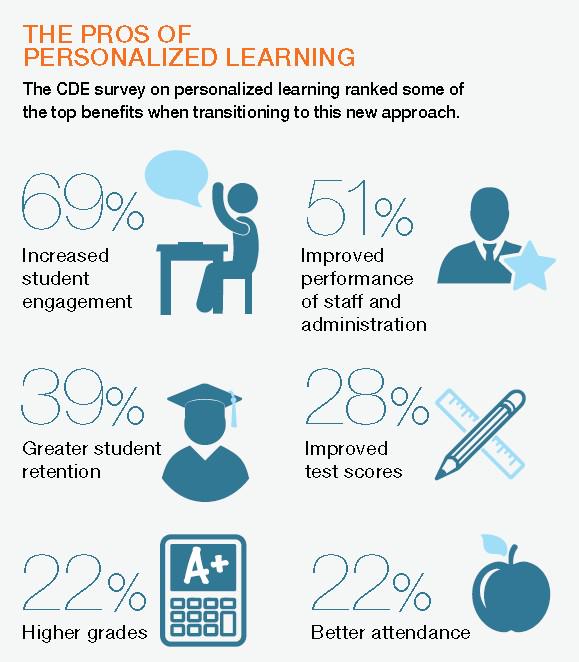
Collaboration is not just what happens during your collaboration time but also what happens outside of it.  Collaboration is about personalizing your own learning to be better at something you are passionate about or improve on a personal area of difficulty.  Personalized learning is concept in which educators use technology resources and colleagues to work on an area of that would like to improve on.  When we select an area for growth and develop a plan to ensure growth occurs, students always win.  Below is a infographic that I found on Twitter that shows the results of educators engaged in personalized learning.  When we all are learning, we all are improving the learning for our students.


College & Career Readiness
We are excited to report that we have purchased a new software program called Career Cruising.  This software will help our students not only select a college and career pathway, but it will help parents, teachers and students define what students must do in school now to be prepared to enter their college and career pathway of choice.  Students will be able to register themselves for classes online and develop their own Personal Graduation Plan (PGP) online.


TIP (Tech Integration Pic) of the Week

by Cindy Haston
Students in Kevin Grace's English II honors class are competing in CSPAN's student documentary project StudentCam.  StudentCam is C-SPAN's annual national video documentary competition that encourages students to think critically about issues that affect our communities and our nation.  The theme this year is "The Three Branches of Government and You" and students must combine CSPAN footage of national leaders discussing current events with local video describing the impact of these global issues on our community. 
Students participating in the competition must complete regular class work on their own time so that they can use class time to collaborate with peers on creating their videos.  Students also meet and work outside of class time to get interviews and other footage required for their videos.

The documentaries are due January 20th.

Wednesday, January 7, 2015

1st Week of 2015 - Happy New Year

I hope each of you had a restful and rewarding Christmas break, and I hope that the start of 2015 has been a pleasant one for you.  As you come back, I want to remind you of how much power you have to change the trajectory of a child's life.  What you do each and every day has the potential to transform children, (no matter their background or history), into amazing and productive human beings.

Inspiring and Motivating  kids to believe in themselves and their potential is how you remove the 
I & M from impossible.

Testing Calendar - Don't forget to put testing dates into your calendar.


DOK - Using the SAMR Model to get to Level 3

Exit Ticket aligned to SAMR


Collaboration

What is the purpose of collaboration?  To be meaningful, the purpose of collaboration should be to work with and learn from your colleagues.  For that to occur, we should all take turns leading the learning for our peers.  In other words, everyone has expertise, and if that expertise is helping kids grow in their learning, then we are morally obligated to share our expertise with others.

A perfect example of being a Lead-Learner is Teresa Nelson, TPS kindergarten teacher.  In Monday's professional development day, Teresa volunteered to lead the learning of her fellow kindergarten teachers on the topic of using their new interactive Mimio bars.  What made this collaboration special is that Teresa saw a need and took the initiative to prepare training for her peers about this fantastic technology.  If we believe in "Excellence for All", then we all must view collaboration as our opportunity to help our peers guarantee "Excellence for All" by teaching peers our successful strategies and by constantly learning from one another.


On Jan 5, TMS & THS honors teachers
collaborated on ways to motivated unmotivated
students via a Webshop through Region 7

College & Career Readiness
Are you looking for enrichment ideas in 2015?  Then why not engage kids in finding out what careers are aligned with their strengths and interests?  Every student has a potential career inside them.  They just need the perfect learning opportunity to discover where their strengths could lead them.  Check out this website to orient your students or your own children toward careers that are aligned to their strengths  and interests.   TexasGenuine.org


TIP (Tech Integration Pic) of the Week

STEM article - Tinkering is Serious Play via ASCD

CanvaCheck out what my Kids Created on Canva


Student Communication

Communication to students about learning targets is extremely important.  It is so important that we must communicate in both written and verbal forms what we expect kids to learn today and what the learning should actually look like.  Below is a picture of Paulette Brown's board.  Her 8th grade science students not only know what the learning target for the week looks like, but she goes the extra mile to make sure that the critical details are communicated in a way that all students can see what is expected of them.  Great job to Ms. Brown